|
Jessica Schwartz |
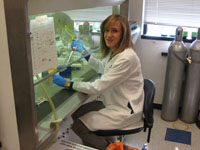 |
PH.D. Candidate of Science (Oncology) |
| |
Description of my work (in technical terms): |
| Antiestrogens (AE) are effective therapies for the management of many estrogen receptor-α (ER)-positive breast cancers. However, both de novo and acquired resistance to antiestrogens remains a major obstacle in the clinical setting. To address this, the underlying mechanism of antiestrogen resistance must be understood. The transcription factor interferon regulatory factor-1 (IRF1) is a well-established tumor suppressor gene that increases antiestrogen sensitivity by inducing apoptosis in breast cancer cells. Increased IRF1 activation inhibits the expression of prosurvival (i.e., BCL2, BCLW) and induces the expression of proapoptotic members (i.e., BAK, BAX) of the BCL2 family. My work focuses on whether IRF1 promotes AE sensitivity by regulating specific BCL2 family members. I am investigating the functional significance of BCL2 members in AE responsiveness using transient manipulations of expression. I have also generated a dominant negative form of IRF1 (dnIRF1), which prevents the induction of proapoptotic members in AE exposed sensitive cells. My work also includes testing the ability of various BCL2 inhibitors to inhibit cell proliferation in dnIRF1 expressing cells by increasing the levels of proapoptotic BCL2 family members. This could, in turn, facilitate mitochondrial dysfunction in vitro and in vivo. By focusing on IRF1 regulation through BCL2 family members, my work will elucidate how breast cancer cells become resistant to endocrine therapy. |
| |
Description of my work (in layman terms): |
| The chance that a woman will develop invasive breast cancer in her life is less than 1 in 8, making breast cancer the second most common cancer among American women. About 70% of breast cancer tumors seen in the clinic are estrogen receptor-α (ER)-positive, making them ideal candidates for endocrine therapy, such as an antiestrogen or aromatase inhibitor. Although improvements in overall survival are well documented, resistance to endocrine therapy is a major limitation in the successful treatment of breast cancer. My research focuses on the tumor suppressor gene, interferon regulatory factor-1 (IRF1), which is lost in approximately 30% of spontaneous breast tumors. Moreover, loss of IRF1 is associated with antiestrogen resistance, making it an important player in breast cancer. Our goal in the clinic is to restore IRF1 expression and, in turn, resensitize breast tumors to antiestrogens. By focusing on IRF1 regulation of cell death, I will elucidate how breast cancer cells are selected for death so that we can restore these processes in the clinic. |
| |
|
|
